
Quo Vadis Christian Documentary Review: Where Is the Church Going?
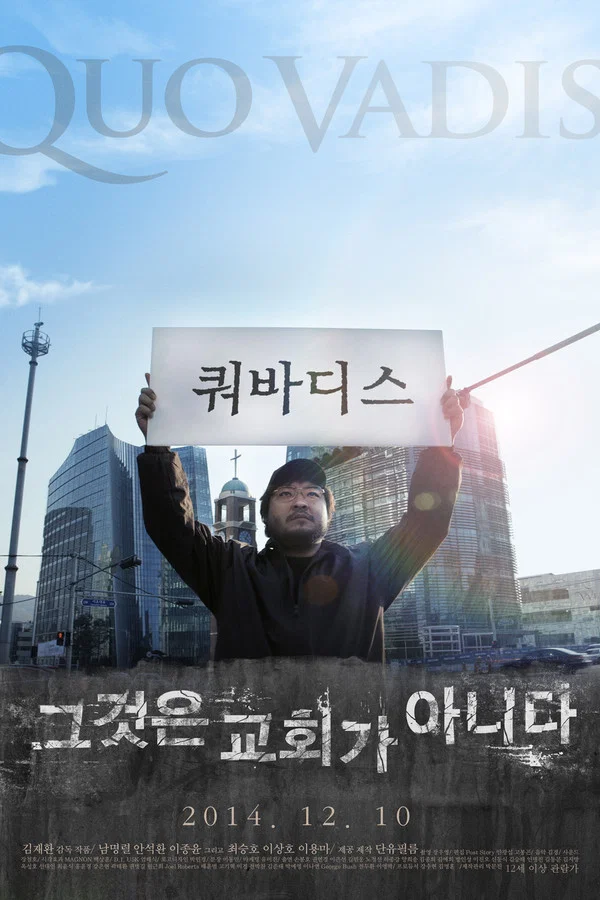
| 🎬 Title & Year | Quo Vadis (쿼바디스, 2014) |
| 🎥 Director | Kim Jae-hwan |
| 👥 Featuring | Lee Jong-yoon, Ahn Suk-hwan, Nam Myeong-ryeol |
| 🕒 Genre / Runtime | Documentary · 104 mins |
| 🔞 Rating | 12+ (South Korea) |
| ✝️ Core Faith Themes | Church Growth vs. Spiritual Growth, Servant Leadership, Money and Power, Repentance, The Body of Christ |
| 📖 Key Scripture | Matthew 7:21–23, Mark 10:42–45, Mark 12:41–44, 1 Corinthians 12:27, 1 Peter 4:17 |
Table of Contents
Before I talk about this documentary with you, I first want to say that I feel ashamed. The problems shown on the screen did not feel like stories about “some strange churches” somewhere else. As a fellow Christian, they felt uncomfortably close to our own story. Quo Vadis examines Korean megachurches, hereditary succession in church leadership, and the relationship between money and power. It also touches on SaRang Community Church, founded by the late Pastor Oak Han-heum, a pastor I have respected for many years.
When I was a university student in my twenties, I often visited SaRang Community Church’s former building. Every year, I also watched documentaries related to Pastor Oak Han-heum and encountered his philosophy of ministry and his concerns about the Korean church. One statement that has remained in my memory for a long time was his confession that, as the church grew and people seemed to gather in crowds, he felt fear rather than simple excitement.
At the time, I thought that sounded strange. Wouldn’t a pastor normally rejoice when more people came to church? Why would growth make him afraid? Looking back now, perhaps he understood better than most that a larger number of people does not automatically mean a healthier church.
As I watched Quo Vadis and searched through related articles again, one thing that weighed especially heavily on me was a comment attributed to Pastor Oak Han-heum’s son, comparing the enormous new church building to something like a sinking Titanic. That image made me think about how wide the distance can become between the kind of ministry Pastor Oak pursued and the way a megachurch may eventually be perceived by people watching from the outside.
A Bigger Church Does Not Mean a Bigger Faith
Before I came to the United States, when I was working in Seoul editing commercial videos, I attended worship services several times in SaRang Community Church’s new building. When you step off the subway, the church is almost immediately connected to the station. The exterior is covered with beautiful glass, the interior contains countless escalators, and the scale is so enormous that for a moment I remember thinking, “Is this really a church?” The size of the main sanctuary is overwhelming in itself.
I do not want to say that the faith of the people worshiping there is wrong. I am a sinner in need of the same grace of God they need, so how could I casually judge another person’s faith? Yet whenever I see a megachurch, one question continues to remain with me: Is a church becoming larger really the same thing as the faith of each person inside it becoming deeper?
I do not think it is. A church gathering thousands or tens of thousands of people does not mean that every person in that community is living a healthy Christian life. At the same time, a small church is not automatically spiritually deeper simply because it is small. Ultimately, the most important question is not the size of the congregation but how each person is actually living before God.
We sometimes look at a church with a famous pastor, enormous attendance, or an impressive building and unconsciously assume, “God must have greatly blessed this church.” But Scripture does not measure the health of the church by the height of its building or the number of people sitting in the sanctuary.
Jesus called disciples and taught them to follow Him with their lives. A pastor has an important responsibility to teach and care for believers, but a pastor cannot take responsibility for our faith in our place. No matter how excellent the sermon I hear every Sunday may be, if I do not pray before God, read His Word, love my neighbor, or seek to obey Christ, simply attending a famous church cannot substitute for my own life of faith.
That is why, when I look at a megachurch, I sometimes think first about the greater responsibility that comes with greater size. The more people there are, the more difficult it becomes to care for each individual. The larger the organization becomes, the greater the danger that the church can begin functioning like a massive institution. Numerical growth can certainly be a blessing, but the moment we begin boasting in those numbers, the blessing itself can become a dangerous temptation. Jesus warns in Matthew 7:21–23 that impressive religious activity does not automatically prove that a person truly knows Him. His warning reminds us that outward success and inward faithfulness are not always the same thing.
When Ministry Becomes Power Instead of Calling
One reason Quo Vadis is uncomfortable is that it looks directly at the problem of power inside the church. Hereditary succession in pastoral leadership is not separate from that issue. We cannot say that it is inherently sinful for the child of a pastor to become a pastor. A son or daughter who grows up watching a parent’s faith and ministry may naturally feel called to walk a similar path.
The problem begins when the church starts to be treated as though it belongs to one family. The church does not belong to the pastor. It does not belong to the elders. It does not even belong to the members who have served there faithfully for decades. The church is the body of Christ. As 1 Corinthians 12:27 says, believers together are Christ’s body, and each person is a part of it. If that is true, it is understandable that people begin asking questions when the position of senior pastor appears to pass naturally within one family as though it were corporate ownership being transferred to the next generation.
Jesus gave His disciples a radically different picture of leadership. In Mark 10:42–45, He tells them that the rulers of the Gentiles exercise authority over others, “Not so with you.” Instead, whoever wants to become great must become a servant, and Jesus points to Himself as the One who came not to be served, but to serve and to give His life for others. In Christianity, the authority of a leader does not ultimately come from climbing to a higher position. It comes from becoming lower in order to serve.
So when ministry becomes a position of status, and when institutions and power begin to be mobilized to preserve that position, we need to ask an extremely serious question: Are we really building the church of Jesus Christ, or are we building a human kingdom?
Money Does Not Prove the Size of Our Faith
I remember watching documentaries about Pastor Oak Han-heum in which he said that pastors themselves needed to repent for the condition of the Korean church. His strong criticism of greed among pastors and the church’s relationship with money also remained with me for a long time. Honestly, as a Christian, I feel ashamed even having to talk about these things. If the church tells the world to let go of greed while constantly being criticized for conflicts involving money and finances inside the church itself, what exactly are we showing to people outside the faith?
The Bible does not say that money itself is evil. Money can be used for good. Churches need financial resources to support missionaries, care for the poor, operate ministries, and educate the next generation. But Scripture gives very serious warnings about the love of money. Even within the church, we can sometimes make the strange mistake of connecting the amount someone gives with the strength of that person’s faith. Someone who gives a large offering may appear to be a person of strong faith, while someone who gives little may be quietly viewed as spiritually immature. That is a deeply dangerous way to think.
Jesus watched a poor widow put two small coins into the temple offering. In Mark 12:41–44, the amount she gives is far smaller than the large contributions of the wealthy, yet Jesus says that she has given more than all the others because He sees not merely the number, but the heart and sacrifice behind the gift. What mattered to God was not simply how much she gave, but the heart with which she gave it.
Having more money does not mean having greater faith. Having less money does not mean having weaker faith. A larger church building does not mean that people love God more, and raising enormous amounts of money does not necessarily prove that God’s will is being accomplished more faithfully. Money must remain a tool of the church rather than becoming its purpose. The moment the tool becomes the goal, the church enters dangerous territory.
Comparative Analysis: Success by the World vs. Health in the Church
| Question | Worldly Measure of Success | Biblical Measure of Health |
|---|---|---|
| Growth | How many people attend? | Are people actually becoming disciples of Christ? |
| Leadership | How much authority and influence does the leader possess? | Does the leader use authority to serve others? |
| Money | How large is the budget or offering? | Is money being used faithfully as a tool for ministry? |
| Identity | Is this a powerful and recognizable institution? | Does this community increasingly resemble Jesus Christ? |
Why I Still Refuse to Give Up on the Church
After watching this documentary, perhaps the easiest conclusion would be to say, “The church is hypocritical,” “Pastors only care about money,” or “I should just leave the church.” But I do not want to end there, because the failure of the church is not the failure of Jesus Christ. Churches are filled with sinners, and I am one of them. That means problems will always be possible inside the church. Pastors can fall. Members can fail. Entire communities can move in the wrong direction. We should never ignore those failures, but abandoning the church itself because of those failures cannot be the full answer either.
Instead, when we see the failures of the church, we should ask again what the church actually is. Is the church a beautiful building? Is it a famous pastor? Is it a Sunday service attended by tens of thousands of people? Scripture calls the church the body of Christ. If that is true, then the real question should not be, “How big is our church?” but “How much is our community becoming like Jesus?” Buildings eventually grow old. Famous pastors eventually leave their positions. Attendance numbers rise and fall. But a community that continues to love, serve, repent, carry one another’s burdens, and become more like Christ can continue holding onto the true identity of the church.
As I watched Quo Vadis, I wanted first to examine myself rather than point a finger at another church. Am I consuming church? Have I come to believe that listening to a good sermon and enjoying good programs fulfills my responsibility as a Christian? Am I hiding behind a pastor’s preaching so that I do not have to wrestle with God personally? This may be one reason the story of Pastor Oak Han-heum feeling afraid as his church grew has remained with me for so long. Perhaps he was not afraid because the church was too small. Perhaps he was afraid that a church becoming so large might eventually lose sight of what mattered most.
The title of the documentary, Quo Vadis, asks, “Where are you going?” To me, that question feels directed toward the Korean church. Church, where are you going? Are you moving toward larger buildings? More people, more money, and greater influence? Or are you moving toward Jesus Christ, who carried the cross and lowered Himself to serve?
And that question is not only for pastors. Where am I going?
I hope that the shame I feel as a fellow Christian does not end merely as embarrassment, but leads to repentance. Before criticizing another church, I want to examine my own faith. I want us to look more closely at the character of Christ than at the size of a church, and to value service and love more than money and power. 1 Peter 4:17 says that judgment begins with God’s household. That verse should not become a weapon for attacking other Christians; it should first make us ask whether we ourselves are willing to stand honestly before God and repent.
Perhaps the most important question Quo Vadis leaves us with is this:
“Are we really building the church of Christ, or are we building our own kingdom and placing Christ’s name on it?”
Key Takeaways & Faith Insights
- A Bigger Church Does Not Automatically Mean a Deeper Faith: The size of a church and the spiritual maturity of an individual are not the same thing. What matters most is not how large the community we belong to is, but whether we are actually living in obedience before God. Matthew 7:21–23
- Christian Leadership Is a Call to Serve, Not to Rule: Jesus defined leadership not by possessing power, but by lowering oneself to serve. Positions and influence in the church should never become personal or family power; they exist to serve the body of Christ. Mark 10:42–45
- God Looks at the Heart, Not the Size of the Offering: The amount someone gives does not prove the size of that person’s faith. Jesus saw beyond the amount of the widow’s offering and looked at the heart and sacrifice with which she gave. Mark 12:41–44
- Reform Begins with Repentance, Not Finger-Pointing: Criticizing the failures of others is not enough. As members of the same body of Christ, we must first examine ourselves, repent, and work together so that the church can return to its true calling. 1 Peter 4:17
“Quo Vadis?”
“Where are you going?”
Explore More Screen Devotions:
- 🎬 Movies: Explore Other Faith-Based Film Reflections
- 🎨 Animation: Spiritual Insights in Animated Films
Scripture taken from the Holy Bible, NEW INTERNATIONAL VERSION®, NIV® Copyright © 1973, 1978, 1984, 2011 by Biblica, Inc.® Used by permission. All rights reserved worldwide.