
Choir of God Christian Review: What It Means to Worship Freely
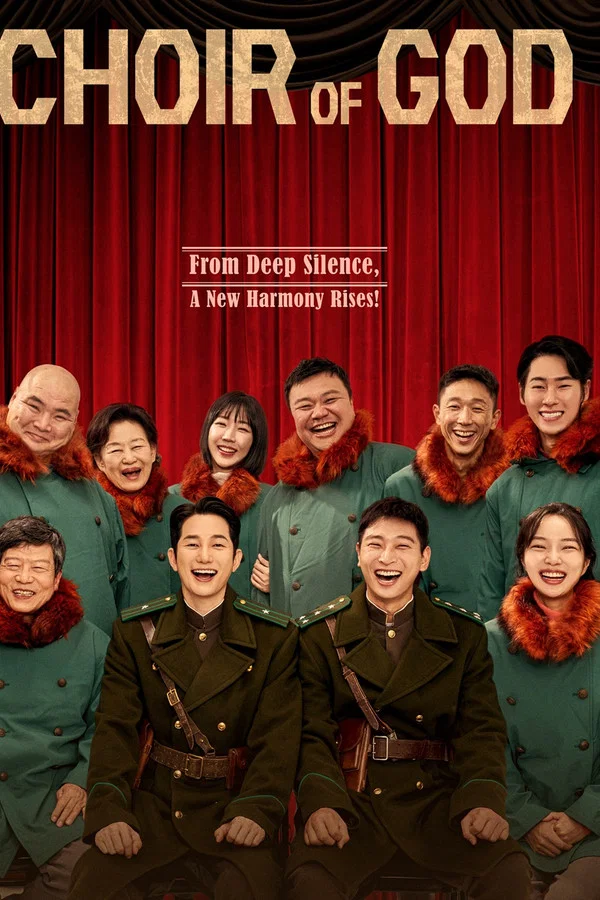
| 🎬 Title & Year | Choir of God (신의악단, 2025) |
| 🎥 Director | Kim Hyung-hyup |
| 👥 Starring | Park Si-hoo, Jeong Jin-woon, Tae Hang-ho, Jang Ji-gun, Han Jung-wan |
| 🕒 Genre / Runtime | Drama · 110 mins |
| 🔞 Rating | 15+ (South Korea) |
| ✝️ Core Faith Themes | Excellence as Worship, Persecuted Faith, Genuine Worship, Religious Freedom, Remembering the Underground Church |
| 📖 Key Scripture | John 12:24, Colossians 3:23, Hebrews 13:3, Acts 4:18–20, Psalm 100:2 |
Table of Contents
Recently, through Secret Sunshine, we reflected together on the idea of “cheap grace.” This time, I would like to raise a very different question through another Korean film: director Kim Hyung-hyup’s 2025 film Choir of God. The film begins with an ironic premise in which the North Korean authorities organize a “fake praise band” to earn foreign currency under international sanctions, and through that story it explores religious persecution in North Korea and the faith of underground Christians. The fact that the film was inspired by real events makes its subject matter feel even heavier. Yonhap News Agency
It is not that I had never been interested in missions to North Korea or stories about underground churches there. For many years, I had heard stories of North Korean Christians who had to practice their faith in hiding. So when my wife and I watched Choir of God, I went into the film with considerable expectations. But to be completely honest, as much as I was spiritually moved by parts of the film, I also came away with quite a few disappointments.
I graduated from a Christian media and video production program in Korea. During college, I was deeply interested in Christian film, media, and cultural content, and I also produced videos myself. One subject my professors, friends, and I discussed countless times was how, compared with the Christian cultural-content industry in the United States, Korea’s Christian film and media industry was still relatively small and working under difficult production conditions. Simply being labeled a Christian film can make investment and distribution more difficult, which often forces filmmakers to work with limited budgets. For that reason, I have long believed that the Korean church should more actively encourage and support this kind of cultural ministry and the creators working within it.
Perhaps because of that background, while watching Choir of God, I found myself thinking almost as much about the filmmaking as about the message itself: “Could this have been made just a little more solidly?” Ironically, however, that disappointment caused me to think about the film for even longer. Not because the movie was perfect, but because the question raised by the story of people who must hide because of their faith is simply too important to ignore.
A Good Message Alone Does Not Make a Good Film
The part of Choir of God that disappointed me most was the way the story was connected. There were scenes in which the characters, while traveling for performance rehearsals, suddenly began singing praise songs in the middle of a snowy landscape, and once the song started, the film would sometimes transform almost into a music video. The music and story did not feel integrated enough for me to see it fully as a musical, yet at other times the songs seemed to interrupt the flow of what otherwise felt like a conventional drama.
I especially think Park Kyo-sun’s past had enough dramatic power to become the heart of the entire film. As a child, he saw his mother reading the Bible and, without understanding what it meant, told his schoolteacher about it. His mother was eventually branded a reactionary and executed. That is an extraordinarily powerful setup. If a man who had spent his life distancing himself from faith because of that trauma later encountered underground Christians and was forced to confront his past and his identity, that alone could have carried the entire film. Personally, however, I felt that his past, his internal transformation, and the process leading to his conversion moved too quickly.
I also did not fully understand the death of the oldest member of the band as they moved toward the final performance. After the movie, my wife and I talked about another possible ending: “What if the members who escaped had returned, completed the performance together to the very end, and ultimately faced death together because of their faith?” Of course, that is only an ending we imagined ourselves. But if the story had ended that way, I wondered whether it might have connected even more powerfully with the image in John 12:24 of a grain of wheat falling to the ground, dying, and producing many seeds.
I do not believe that a film should be exempt from criticism simply because it is Christian. On the contrary, if the gospel message we want to communicate is precious, should we not think even more seriously about the story and images that carry it? Faith is not a license that excuses weak craftsmanship. I believe that a Christian creator doing his or her very best with God-given talents to tell a good story can itself become an act of service offered to God.
People Who Can Lose Everything Because of a Single Bible
Yet regardless of the film’s weaknesses, the situation of North Korea’s underground church portrayed in Choir of God cannot simply be brushed aside. In this film, the Bible is not a book that can sit casually on a shelf in our homes. Simply possessing one can become a dangerous act capable of destroying the life of an individual and an entire family.
The memory of Park Kyo-sun’s mother being branded a reactionary because she read the Bible becomes a wound he has buried throughout his life. When another character’s family is tortured and someone confronts him with words essentially asking, “You know this too, don’t you?” the past that Kyo-sun himself has tried to ignore begins to return. For him, Christianity was never first associated with a warm church or beautiful worship music. Instead, it was connected to the terrifying memory of losing his mother.
And yet this same man slowly begins to change as he spends time with believers from the underground church. Here I found the first important Christian theme of the film: faith does not simply disappear because it is oppressed. Church buildings can be taken away. Bibles can be banned. People can be imprisoned. But it is far more difficult to erase completely the traces of faith that remain deep within a person’s heart.
The early church also began in the midst of persecution. Christians were imprisoned because of their faith, and some even lost their lives. Yet the gospel did not disappear. The hidden believers in Choir of God therefore confront us with deeply uncomfortable questions: I am free to read the Bible—but how much do I actually read it? I am free to pray—but how much do I actually pray?
When Fake Praise Becomes a Real Confession
The most fascinating premise of the film is that the praise band itself is originally “fake.” The North Korean regime has no intention of worshiping God. Its purpose is to deceive the outside world and gain economic benefits. Yet ironically, while practicing fake worship, the characters encounter people who possess genuine faith, and through those encounters they begin to examine their own lives and beliefs.
Here I found the second important Christian theme: people may begin with false motives, but God can still move a human heart even within those circumstances.
At first, Park Kyo-sun is simply an officer carrying out an assignment. But as he witnesses the faith and sacrifice of the band members at close range, he is forced to face memories of his mother that he had buried for years. I still wish the film had explored his conversion more deeply on a dramatic level, but the direction of the story itself contains a meaningful paradox: inside a fake Christian band created by a state that does not believe in God, someone begins to think about God again.
We also need to examine whether the outward actions of our faith truly match what is happening within our hearts. We can freely attend church and sing praise. But is the praise coming from our mouths really our confession, or has it become nothing more than a religious habit repeated every week? The people in Choir of God begin by singing without believing, but gradually those songs begin to become their own story. In contrast, we may claim to possess genuine faith while singing praise without thinking at all.
Comparative Analysis: Fake Praise vs. True Worship
| Category | Fake Praise | True Worship |
|---|---|---|
| Purpose | To deceive outsiders and gain political or economic benefit | To honor God and respond to Him with sincerity |
| Heart | The words are sung without personal faith or conviction | The words become a genuine confession of faith |
| Cost | Worship is performed because the state commands it | Worship may cost believers their freedom, safety, or even their lives |
| Spiritual Question | Can religious performance exist without genuine faith? | Does the praise we freely sing truly reflect what is in our hearts? |
The Freedom We Take Far Too Much for Granted
What stayed with me longest after the film was ultimately this: I now live in the United States, where I can open a Bible without asking anyone’s permission. The police do not come looking for me because I attend church. I can turn worship music up loudly in my car, and I can write about Jesus online. Christians living in South Korea likewise enjoy an extraordinary degree of religious freedom when compared with believers in North Korea’s underground church. Sometimes we are so free that we forget how precious that freedom actually is.
Hebrews 13:3 tells us to remember those in prison as though we ourselves were imprisoned with them. Christians in North Korea’s underground church are not simply distant people appearing in the news. They are our brothers and sisters who belong to the same body of Christ. If that is true, then praying for them cannot be something reserved only for Christians with a special interest in North Korean missions.
This is the third and, for me, the most important Christian message I discovered through Choir of God: remembering the persecuted church also means becoming grateful for the freedom of faith that we ourselves have been given.
Of course, I still have many reservations about the film. Even the sequence during the end credits, where the entire cast gathers on a church platform and sings “Way Maker,” was difficult for me to interpret clearly within the story itself. Perhaps it represents everyone meeting again in heaven and worshiping together. Perhaps it is simply a special performance from the cast and production team to the audience outside the narrative of the film. Several interpretations are possible, but personally, I felt that the sequence was somewhat separated from the main story.
Perhaps because I have experienced the Korean Christian video-production environment myself, I naturally found myself thinking about the relationship between churches and production environments behind scenes like this. Still, I cannot claim to know the filmmakers’ intentions without evidence.
Even so, I believe the very existence of Choir of God has meaning. If the Korean Christian film industry still has much room to grow, our response should not simply be to criticize it and turn away. We should take interest, encourage creators, offer healthy criticism when necessary, and help create an environment in which better films can be made.
And above all, when the movie ends, I hope we remember one very simple truth. Somewhere in the world today, there is someone who must hide a Bible. There is someone who must sing praise in a small voice so that no one else will hear. There is someone who must risk freedom—and even life itself—simply because they believe in Jesus. Compared with them, the fact that we can open the doors of a church on Sunday morning and walk inside without fear is anything but ordinary.
So I hope that as we pray for them, we will also give thanks for the freedom we have been given. And I hope we do not become so accustomed to being free to believe that we begin to take faith itself lightly. Perhaps the most important question Choir of God leaves us with is this:
“If I can worship God without fearing anyone, how much do I truly treasure that freedom?”
Key Takeaways & Faith Insights
- Excellence Can Also Be an Act of Worship: A valuable Christian message does not mean that storytelling and craftsmanship should be treated lightly. Doing our best with the talents God has given us can itself become an act of service offered to Him. Colossians 3:23
- Remember the Persecuted Church: Christians who hide and suffer because of their faith are not strangers to us. As brothers and sisters belonging to the same body of Christ, we are called to remember their suffering and pray with them. Hebrews 13:3
- Faith Can Survive Even Under Oppression: Authorities may ban Bibles and public worship, but they cannot completely erase faith planted within the human heart. Park Kyo-sun’s buried memories and the underground church remind us of a faith that survives even under oppression. Acts 4:18–20
- Do Not Take the Freedom to Worship for Granted: The freedom to attend church, read Scripture, and praise God openly is not an ordinary reality for every Christian. We should not take that freedom for granted, but serve God with gratitude. Psalm 100:2
“Hey! Believing in Jesus is an order from the Party!”
Park Kyo-sun
Explore More Screen Devotions:
- 🎨 Animation: Spiritual Insights in Animated Films
- 🌍 Documentaries: Biblical Perspectives on Real-World Issues
Scripture taken from the Holy Bible, NEW INTERNATIONAL VERSION®, NIV® Copyright © 1973, 1978, 1984, 2011 by Biblica, Inc.® Used by permission. All rights reserved worldwide.