
Interstellar, God’s Providence, and a Love Beyond Time
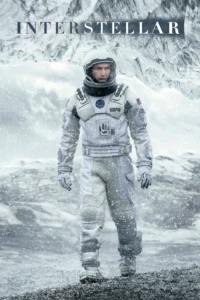
| 🎬 Title & Year | Interstellar (2014) |
| 🎥 Director | Christopher Nolan |
| ⭐ Starring | Matthew McConaughey, Anne Hathaway, Jessica Chastain, Michael Caine |
| 📌 Genre / Runtime | Sci-Fi, Drama, Adventure · 169 mins |
| 🔞 MPA Rating | PG-13 |
| ✝️ Core Faith Themes | Divine Sovereignty, Transcendent Love, God’s Omnipresence, Covenant Promises |
| 📖 Key Scripture | Romans 8:38–39, Psalm 19:1 |
Table of Contents
Interstellar was the very first film I ever watched entirely alone in a movie theater. My anticipation was extraordinarily high, not only because the premise fascinated me, but because it was directed by Christopher Nolan.
Anyone who has seen the film will remember the chilling sequence when Dr. Mann forcibly opens the airlock, causing an explosion on the Ranger and part of the Endurance. In that exact instant, the film strips away its roaring score, plunging the entire theater into the absolute silence of the vacuum of space. The cinema was packed to the last seat, yet not a single person breathed. Everyone was utterly frozen, captivated by the raw vastness on screen.
In this post, I want to share an Interstellar Christian reflection through the lens of a biblical worldview, exploring how our Creator continues to reach out and send us signals across the dimensions of our lives.
Humility Before the Infinite Cosmos
The primary canvas of Interstellar is, of course, the boundless cosmos. Space is far wider, deeper, and more unfathomable than human comprehension can grasp. During my undergraduate years, a professor posed an unforgettable question during our very first lecture: “When you look at the sun outside, what comes to mind? When you look at the trees, what do you think?”
Caught off guard on day one, I sat in silence. My professor gently challenged the room: “When we look at the sun and the trees, shouldn’t our thoughts immediately turn to God? If we, as created beings, cannot instantly recognize the Creator through His creation, there is a fundamental disconnect in our spiritual sight.”
While I am not suggesting that watching Interstellar automatically replaces spiritual devotion, the sheer majesty of space naturally leads us to humility. Facing a universe created by God—alongside the sun, the trees, and all living things—humanity realizes just how small we truly are. This parallels the breath-holding reverence of that theater crowd during the vacuum scene. Hans Zimmer’s magnificent pipe organ score further amplifies this, transforming the vast cosmic void into a sacred space of awe. In much the same way, our everyday lives are continually held within the overwhelming, awe-inspiring love of God.
The Tesseract and God’s Sovereign Providence
Geometrically, a tesseract is a 4-dimensional hypercube. In the film’s narrative, however, it is presented as a construct built by fifth-dimensional beings, designed specifically for a three-dimensional human like Cooper. It translates time into a physical, spatial dimension. Inside the tesseract, time unfolds as tangible geometric axes, allowing Cooper to navigate between Murphy’s childhood and adulthood while transmitting gravitational data across the bedroom bookshelf.
As the physicist Romilly famously demonstrates using a folded piece of paper pierced with a pencil, bending higher dimensions creates a bridge across spacetime. Viewers witness the beginning and end of the story seamlessly folding into one. When Dr. Brand experiences the distorted “handshake” while crossing the wormhole—which is later revealed to be Cooper reaching back through spacetime—we realize that time in this universe is not merely a flat linear line, but an intricately interwoven tapestry.
Scripture reveals that God is not bound by linear time; He exists in the past, present, and future simultaneously. God already knows the steps we take and prepares our path before we even walk it. Cooper’s desperate plea from within the tesseract—watching himself leave Murphy and shouting, “Don’t go!”—mirrors our limited human vantage point. Yet God, who sees the entire timeline, remains sovereign.
Having studied theology during my university years, I learned that Christ is both fully God and fully human. Because of His true humanity, He understands our sorrow, weeping at the tomb of Lazarus (John 11:35) and crying out in agony at Gethsemane.
God speaks and works in dimensions far beyond what our eyes can register. Yet, knowing God sees the future does not justify fatalism or reckless living. Although God knows our story, we are broken beings who fall short daily. That is why we are called to daily prayer, meditation, Scripture reading, and repentance. Recognizing divine sovereignty while walking in faithful obedience is the core message Interstellar illuminates through a biblical lens.
A Love That Pierces Spacetime
Through Cooper’s journey inside the tesseract, we see a reflection of God’s omnipresence. But there is a deeper reality: God does not just exist across all dimensions—He loves us across all dimensions.
The God of our past has poured out His love upon us; the God of our present sustains us with that same grace; and the God who already inhabits our future is waiting with unfailing mercy. Knowing that God’s love transcends every boundary of time and space transforms our daily walk, assuring us that our lives and labors are never in vain.
Near the conclusion of the film, an elderly Murphy reunites with her father and confesses that she always knew the mysterious force behind the bookshelf was him, not an alien presence.
Murphy: “Nobody believed me, but I knew who it was. Nobody believed me, but I knew you’d come back.”
Cooper: “How?”
Murphy: “Because my dad promised me.”
“Because my dad promised me.” This simple line carries tremendous weight. God our Heavenly Father has given us His eternal promise and covenant: that He will never leave us nor forsake us, even to the end of the age. That covenant is recorded across the pages of Scripture.
Are we living each day anchored in faith toward the promises our Father has spoken?
Even in this very moment, God is sending His signals of redeeming love straight to your heart.
“For I am sure that neither death nor life, nor angels nor rulers, nor things present nor things to come, nor powers, nor height nor depth, nor anything else in all creation, will be able to separate us from the love of God in Christ Jesus our Lord.”
Key Takeaways & Faith Insights
- Humility Before the Infinite Cosmos: The overwhelming vastness of space reflects the majesty of the Creator, drawing our hearts into reverent awe and humble worship.
- The Tesseract and God’s Sovereign Providence: God exists beyond linear time, sovereignly orchestrating the tapestry of our lives while calling us to daily obedience and prayer.
- A Love That Pierces Spacetime: Just as Cooper’s love reached across dimensions, God’s unfailing love and covenant promises pierce every boundary of time, space, and circumstance. (Romans 8:38–39)
“Love is the one thing we’re capable of perceiving that transcends dimensions of time and space.” — Dr. Amelia Brand
Explore More Screen Devotions:
- 🎨 Animation: Spiritual Insights in Animated Films
- 🌍 Documentaries: Biblical Perspectives on Real-World Issues
Scripture taken from the Holy Bible, NEW INTERNATIONAL VERSION®, NIV® Copyright © 1973, 1978, 1984, 2011 by Biblica, Inc.® Used by permission. All rights reserved worldwide.