
The Little Mermaid: Longing, Deception, and Sacrificial Grace
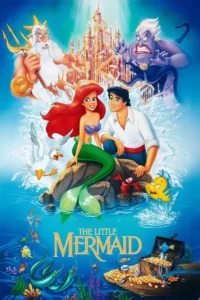
| 🎬 Title & Year | The Little Mermaid (1989) |
| 🎥 Director | Ron Clements, John Musker |
| 👥 Starring (Voices) | Jodi Benson, Christopher Daniel Barnes, Pat Carroll, Kenneth Mars, Samuel E. Wright, Jason Marin, Buddy Hackett |
| 🕒 Genre / Runtime | Animation, Family, Fantasy, Musical · 83 mins |
| 🔞 MPA Rating | G |
| ✝️ Core Faith Themes | Spiritual Longing for Eternity, Deception of Sin & Idolatry, Unconditional Grace (Agape), Substitutionary Atonement, New Creation |
| 📖 Key Scripture | Galatians 3:13, Ecclesiastes 3:11, 2 Corinthians 5:17, Romans 5:8 |
Table of Contents
Welcome to the fifth installment of our Classic Disney Animation series! Today, we explore The Little Mermaid Christian worldview by examining its profound themes of spiritual longing, identity, and sacrificial grace.
The fifth Disney masterpiece we are exploring features a character who was once very close to my personal ideal type—the stunningly beautiful Ariel! Along with legendary tracks like “Under the Sea” and “Part of Your World,” not to mention Prince Eric’s agonizingly oblivious moments in “Kiss the Girl,” we all know and cherish this enchanting film. Today, let’s unpack this beloved classic through a faith-based lens. Shall we dive “Under the Sea” together?
Opening the golden era of the Disney Renaissance in 1989, The Little Mermaid appears on the surface as a simple undersea fairy tale. Yet, looking beneath the surface, it masterfully portrays humanity’s deeply etched longing for a transcendent, heavenly home. As a princess of Atlantica, Ariel enjoys every imaginable beauty and aquatic abundance. However, no amount of material wealth or underwater splendor can fill the profound void in her soul.
Her iconic song, “Part of Your World,” sung as she gathers artifacts from the human world, transcends mere teenage curiosity. It reflects humanity’s spiritual thirst—an innate desire for eternity while bound within a finite world (Ecclesiastes 3:11). The deep ocean is safe, comfortable, and vibrant, yet Ariel’s soul continuously turns toward the sunlit realm above. This closely mirrors the spiritual instinct of believers who refuse to settle for worldly comfort, yearning instead for the Kingdom of God and their true eternal home.
This yearning is remarkably similar to another beloved Disney character, Rapunzel in Tangled. Don’t you think so? While there is much to unpack regarding Rapunzel alongside the story of Samson in a future reflection, her burning desire inside the witch’s secluded tower to discover what lies beyond the horizon mirrors Ariel’s transcendent curiosity.
The Temptation of the Sea Witch and the Penalty of Silence: The Mechanism of Sin
A pure aspiration for a higher realm becomes a deadly snare when pursued through wrongful means. This is where Ursula the Sea Witch enters the narrative. Ariel seeks out Ursula and barters away her most unique, God-given gift—her voice—in exchange for human legs.
Ursula’s deceptive contract mirrors the serpent’s strategy when tempting Eve in the Garden of Eden. She promises immediate freedom, transformation, and pleasure, but the hidden cost is the theft of humanity’s core identity and the voice created to praise God. Our voices were designed to worship the Creator; losing that capability leads to absolute despair. If any of us were challenged to remain completely silent for an entire day without uttering a single word, hardly anyone would find it easy.
Though Ariel gains legs, her inability to speak exposes the profound spiritual paralysis and muted helplessness experienced when humans compromise sacred truth for worldly desires. Sin always flatters us with promises of wings, only to steal the very breath of our souls. Even when Jesus was fasting in the wilderness, Satan approached Him with every cunning temptation. While Christ conquered the devil’s schemes through the Word, frail Ariel succumbed to the witch’s ploy. Does this fragility not mirror our own daily spiritual struggles?
Unconditional Acceptance and Love for Being: Beyond Performance
Stepping onto land, Ariel encounters Prince Eric carrying a devastating handicap: she cannot speak. By worldly metrics, someone stripped of their voice might seem useless, incomplete, or burdensome. Yet Prince Eric is captivated not by eloquent speech or social credentials, but by the sincerity in her eyes and her sheer existence.
In modern terms, imagine a stunning celebrity constantly approaching and circling around you without uttering a single word. In reality, no matter how attractive someone is, our natural reaction is to say hello and try to converse. If they merely stare in complete silence, initial fascination might quickly turn into suspicion, awkwardness, or even unease. Yet Prince Eric responded with patient gentleness.
This dynamic reflects God’s unconditional grace (Agape) that transcends human performance or merit. The world measures human value by eloquence, productivity, and outward achievements. In contrast, Christ’s love welcomes us in our brokenness, weakness, and silent trauma. Just as Prince Eric stood beside Ariel without interrogating her background or exploiting her silence, divine grace is unmerited hospitality freely bestowed upon the unworthy.
This invites us to reflect on our own lives: how do we treat vulnerable, flawed, and struggling brothers, sisters, friends, and family members around us?
King Triton’s Substitution: The Gospel Shadow of the Cross
At the film’s climax, Ariel falls into Ursula’s trap and faces eternal condemnation. The golden contract she signed is legally binding and unbreakable; not even King Triton, with his mighty trident, can tear it apart. Just as the righteous demands of God’s holy law dictate that the wages of sin must be paid, justice cannot simply be swept away.
Yet King Triton does not destroy the law. Instead, to rescue his daughter, he chooses to pay the ultimate price himself. He crosses out Ariel’s name, signs his own name onto the damning parchment, surrenders his golden crown and trident, and willingly embraces the cursed punishment of slavery.
This is a breathtaking shadow of Christ’s substitutionary atonement on the Cross. Because the wages of sin is death, humanity could not escape the righteous penalty of the broken covenant. God sent His only begotten Son, Jesus Christ, to erase our names from the ledger of debt and pay our ransom in full with His own blood.
When we examine the narrative closely, Ariel brought this catastrophe upon herself by chasing worldly desires into a toxic contract with Ursula. Yet her father, the sovereign King, humbled himself, taking the form of a wretched polyp slave in place of his rebellious child. Triton’s sacrifice vividly portrays the profound mystery of biblical substitution.
Consider the beauty of this redemptive motif. It shares strong parallels with Pinocchio, which we explored previously. Pinocchio wandered into worldly indulgence seeking instant pleasure, turned into a donkey, and caused his grieving father to be swallowed by a monstrous whale. Ultimately, Pinocchio gave his life to rescue his father, dying in the turbulent waves before being resurrected into true humanity.
Reflecting on The Little Mermaid today brings a profound realization. When I was young, Ariel was my absolute favorite and ideal character. But revisiting this story as an adult and meditating on its spiritual depth, she often appears reckless, headstrong, and in need of discipline. Her impulsive actions no longer look merely charming. Instead, my heart gravitates entirely toward King Triton. Watching him bear the curse for his undeserving child evokes the immense sorrow and boundless grace of Jesus bearing the Cross for us. It fills me with reverence, tears, and profound awe for the depth of a father’s sacrificial love.
“Christ redeemed us from the curse of the law by becoming a curse for us.”
Are we currently chasing fleeting worldly pleasures through deceptive contracts with the Ursulas of this world? Let us pause today and examine where our hearts truly stand.
Key Takeaways & Faith Insights
- Spiritual Longing for the Eternal Home: Just as Ariel’s heart could not be satisfied with the treasures of the deep sea, humanity carries an innate thirst for the heavenly realm that no worldly wealth or comfort can ever satisfy. (Ecclesiastes 3:11)
- The Deception of Sin and Muted Identity: Exchanging her God-given voice for earthly legs reflects the perilous trap of sin, where trading our true identity for immediate worldly gratification leads to spiritual paralysis and silence. (Genesis 3:6, Romans 1:21–23)
- Unconditional Acceptance Beyond Performance: Prince Eric’s gentle embrace of the voiceless Ariel mirrors God’s agape love, welcoming broken, silent, and imperfect souls purely through unmerited grace rather than outward qualifications. (Romans 5:8, Ephesians 2:8–9)
- Substitutionary Atonement and the Shadow of the Cross: King Triton surrendering his crown and willingly taking the cursed parchment to free his condemned daughter vividly portrays Christ taking the curse of the law upon Himself to redeem us. (Galatians 3:13, Mark 10:45)
“What would I give if I could live out of these waters? What would I pay to spend a day warm on the sand?”
— The Little Mermaid
Explore More Screen Devotions:
- 🎬 Movies: Explore Other Faith-Based Film Reflections
- 🌍 Documentaries: Biblical Perspectives on Real-World Issues
Scripture taken from the Holy Bible, NEW INTERNATIONAL VERSION®, NIV® Copyright © 1973, 1978, 1984, 2011 by Biblica, Inc.® Used by permission. All rights reserved worldwide.